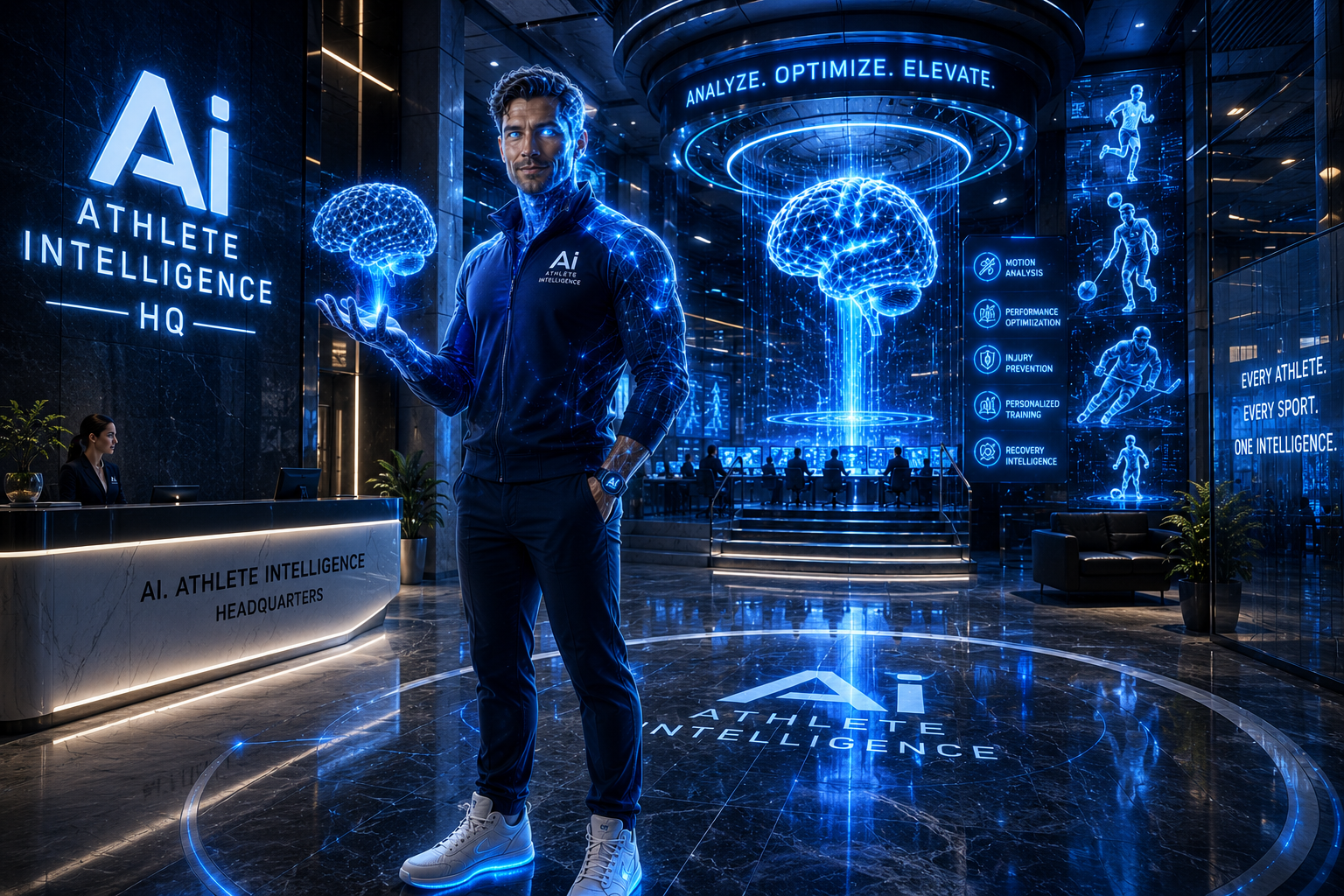
Where sports science meets artificial intelligence. Every hall, every lab, every system in this building exists for one purpose — making you a better athlete.
Explore HQ
Pick a Building.
Every building on campus is a real part of the platform. Tap one to see what's inside.
Film your movement with any smartphone. No special equipment, no setup — just your phone and your game.
02
🦾
Analyze
Motion AI maps your body in real time — joints, angles, force vectors, movement patterns — frame by frame.
03
🧠
Coach
Your sport-specific AI coach delivers precise, personalized feedback — what to fix, how to fix it, and why it matters.
04
💪
Train
Get a custom S&C program built around your sport, goals, and body metrics — then track real improvement over time.
05
📈
Improve
Catch injury risks early, close performance gaps, and build a more efficient athlete — session by session.
Movement Analysis
Biomechanics meets artificial intelligence.
Motion AI uses computer vision and skeletal tracking to build a real-time physics model of how your body moves. It identifies inefficiencies invisible to the naked eye and translates them into coaching you can actually use.
📐 Skeletal landmark mapping
⚡ Real-time vector analysis
🔄 Joint angle computation
🧬 Mobility pattern recognition
🛡️ Injury risk scoring
🤖 AI coaching synthesis
01 — Skeletal Landmark Detection
Motion AI uses a pose estimation model to identify up to 33 anatomical landmarks — shoulders, hips, knees, ankles, elbows, wrists, and more — directly from your smartphone video. Each landmark is tracked at sub-pixel precision across every frame, creating a dynamic skeletal map of your body in motion. No wearables, no markers, no specialized cameras required.
02 — Force Vector & Joint Angle Analysis
From the skeletal data, Motion AI computes force vectors — the direction and magnitude of movement forces acting through each joint. It calculates joint angles in real time: knee flexion, hip hinge depth, shoulder rotation arc, spine alignment, and more. These measurements are compared against sport-specific biomechanical baselines derived from elite performance data, flagging deviations that reduce efficiency or increase injury risk.
03 — Mobility & Range of Motion Profiling
Motion AI builds a dynamic mobility profile for each athlete — measuring functional range of motion at each joint during sport-specific movements. Restrictions in hip internal rotation, limited thoracic extension, or ankle dorsiflexion deficits are identified not in isolation, but in the context of how they affect the full kinetic chain. This identifies the real cause of a performance problem, not just the symptom.
04 — Kinetic Chain & Energy Transfer Modeling
Elite athletic performance depends on how efficiently energy transfers through the kinetic chain — from the ground up through the legs, hips, core, and into the upper body. Motion AI models this chain for each sport-specific movement, identifying where energy leaks occur: early trunk rotation, loss of hip drive, improper sequencing, or compensatory patterns caused by weakness or restriction upstream.
05 — Injury Risk Scoring
Each session generates an injury risk score based on detected movement asymmetries, overload patterns, and compensation strategies. Motion AI flags high-risk patterns — valgus knee collapse, anterior pelvic tilt under load, shoulder impingement mechanics, or lumbar overextension — before they accumulate into injury. Athletes receive specific corrective cues, not just warnings.
06 — AI Coaching Synthesis
All biomechanical data flows into a sport-specific AI coaching layer. Each coach is trained on the movement vocabulary of their sport. The AI synthesizes raw physics data into coaching language an athlete can actually act on — not "your knee valgus exceeds 8°" but "drive your knee out over your pinky toe as you load." Personalized. Actionable. Instant.
07 — Longitudinal Performance Tracking
Motion AI maintains a performance timeline for every athlete — comparing joint angles, force vectors, and movement efficiency across sessions to measure real improvement. It adapts its coaching as athletes develop, progressively addressing deeper layers of inefficiency as foundational patterns improve.
Strength & Conditioning
Custom training. Built for your body.
Every athlete gets a personalized S&C program built around their sport, position, goals, and physical metrics. No generic workouts. No guesswork. Just science-backed training designed to make you stronger, more explosive, and more resilient to injury.
🏋️ Sport-specific load programming
📊 Body metric profiling
🎯 Goal-based periodization
⚡ Power & explosiveness training
🔄 Recovery & adaptation tracking
🛡️ Injury prevention programming
01 — Body Metric Profiling
Before prescribing any training program, Motion AI collects a baseline body metric profile: height, weight, limb length proportions, estimated body composition, and movement-based assessments of strength and mobility. This data is used to calculate individualized training loads, leverages, and joint stress tolerances. Research consistently shows that load prescription based on individual anthropometrics produces superior outcomes versus population-averaged programming.
📚 Reference: Haff, G.G. & Triplett, N.T. (Eds.) (2016). Essentials of Strength Training and Conditioning, 4th Ed. NSCA/Human Kinetics. — Chapter 16: Program Design for Resistance Training.
02 — Sport-Specific Load Programming
Each sport demands a distinct physical profile. A golfer needs rotational power and hip mobility; a football lineman needs maximal strength and collision tolerance; a volleyball player needs reactive jump capacity and shoulder stability. Motion AI selects exercises, rep ranges, tempo, and rest periods matched to the energy systems and movement patterns dominant in each sport. Programs are built around the SAID principle (Specific Adaptation to Imposed Demands), ensuring training stress drives adaptations that transfer directly to sport performance.
📚 Reference: Kraemer, W.J. & Ratamess, N.A. (2004). Fundamentals of resistance training: Progression and exercise prescription. Medicine & Science in Sports & Exercise, 36(4), 674–688.
03 — Goal-Based Periodization
Training is organized in structured phases — typically mesocycles of 3–6 weeks — designed around the athlete's stated goals (speed, strength, hypertrophy, endurance, power) and competitive calendar. Motion AI applies periodization principles including linear, undulating, and block periodization depending on the athlete's training age and timeline. Pre-season, in-season, and off-season blocks are structured to peak performance at the right time while managing accumulated fatigue.
📚 Reference: Issurin, V.B. (2010). New horizons for the methodology and physiology of training periodization. Sports Medicine, 40(3), 189–206. 📚 Reference: Rhea, M.R. & Alderman, B.L. (2004). A meta-analysis of periodized versus nonperiodized strength and power training programs. Research Quarterly for Exercise and Sport, 75(4), 413–422.
04 — Power & Explosiveness Development
For most sports, peak power output — the ability to generate maximal force in minimal time — is a primary performance determinant. Motion AI prescribes plyometric and ballistic training progressions calibrated to the athlete's current strength base (power training is most effective when a minimum strength foundation exists). Programs integrate resisted sprints, jump variations, medicine ball throws, and Olympic lift derivatives based on sport demand and equipment availability.
📚 Reference: Markovic, G. & Mikulic, P. (2010). Neuro-musculoskeletal and performance adaptations to lower-extremity plyometric training. Sports Medicine, 40(10), 859–895. 📚 Reference: Journal of Strength & Conditioning Research — Wilson et al. (1993). The optimal training load for the development of dynamic athletic performance. JSCR, 7(3), 198–202.
05 — Recovery & Adaptation Tracking
Training adaptation only occurs during recovery. Motion AI monitors session load, tracks performance trends across workouts, and adjusts programming when signs of accumulated fatigue or plateau are detected. Athletes log subjective recovery metrics (sleep, soreness, readiness), which are integrated with objective movement quality data from video sessions. Deload weeks are automatically programmed at intervals proven to maximize long-term adaptation.
📚 Reference: Meeusen, R. et al. (2013). Prevention, diagnosis, and treatment of the overtraining syndrome: Joint consensus statement of the European College of Sport Science and the American College of Sports Medicine. Medicine & Science in Sports & Exercise, 45(1), 186–205.
06 — Injury Prevention Programming
Motion AI's movement analysis feeds directly into the S&C program. When biomechanical risk factors are detected — valgus knee collapse, hip abductor weakness, asymmetrical landing mechanics, poor rotator cuff stability — corrective exercises are automatically embedded into the training plan. This integration of movement screening and exercise prescription mirrors the approach used by elite sports medicine and performance departments.
📚 Reference: Hewett, T.E. et al. (2006). Biomechanical measures of neuromuscular control and valgus loading of the knee predict anterior cruciate ligament injury risk in female athletes. American Journal of Sports Medicine, 34(4), 492–501. 📚 Reference: Cook, G. et al. (2006). Pre-participation screening: The use of fundamental movements as an assessment of function. North American Journal of Sports Physical Therapy, 1(2), 62–72. [Functional Movement Screen — FMS]
07 — Nutrition & Recovery Guidance
Performance is built in the gym and protected at the table. Motion AI provides evidence-based nutrition guidance tailored to training phase, body composition goals, and sport demands — including pre- and post-workout fueling windows, hydration targets, and macronutrient ranges. Guidance is based on current sports nutrition consensus, not fad approaches.
📚 Reference: Thomas, D.T., Erdman, K.A., & Burke, L.M. (2016). Position of the Academy of Nutrition and Dietetics, Dietitians of Canada, and the American College of Sports Medicine: Nutrition and Athletic Performance. Journal of the Academy of Nutrition and Dietetics, 116(3), 501–528.